Pipeline
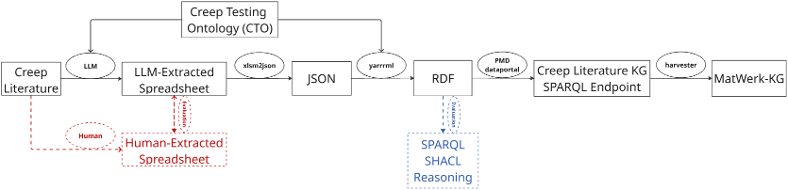
The end-to-end workflow converts creep metadata from scientific publications into validated, ontology-grounded RDF and publishes it on the MaterialDigital Dataportal.
Population workflow
new creep paper
   → LLM4CreepLitKG (LLM extraction, under development) / human extraction
   → data checked by a human and added to creep_literature_spreadsheet.xlsm
   → ./map.sh  (4-step pipeline)
   → creep_literature_rdf.ttl
   → MaterialDigital Dataportal
   → public SPARQL endpoint
   → harvested into MatWerk-KG
Metadata is currently extracted from publications manually into a structured spreadsheet template. The LLM4CreepLitKG component will automate this extraction step; its output will always be validated by a human against the same spreadsheet template before entering the pipeline, so the downstream steps are identical for both extraction routes.
The four-step map.sh pipeline
Running ./map.sh (optionally with a spreadsheet filename as argument) executes the whole pipeline for the entire spreadsheet in one command:
Step 1 — Spreadsheet → JSON (xlsm2json.py)
A generic Python converter reads the single machine-readable header row of creep_literature_spreadsheet.xlsm and produces one JSON array (creep_literature_metadata.JSON) with one object per data row. The converter is purely syntactic and contains no ontology knowledge:
- Cells in
number unitformat (e.g.625 MPa,650 °C,170 µm) become{"value", "unit", "unit_iri"}objects, with QUDT unit IRIs resolved via a lookup table. - Values containing uncertainty or qualifiers (
159.74 ±19.18 h,< 0.02) and descriptive text become{"text": ...}literals, preserved verbatim rather than lossily coerced. - Empty cells are omitted entirely, so absent parameters generate no triples.
- Every parameter object carries an injected
"id"copied from the mandatoryIDcolumn. YARRRML subject templates use$(param.id), so a row where a parameter is absent silently generates no triples for that parameter — zero orphan triples, without any conditional mapping logic.
Step 2 — YARRRML → RML (yarrrml-parser)
The declarative mapping creep_literature_mapping.yaml holds all semantic decisions: every class and property IRI, sourced exclusively from cto.ttl and the ontologies CTO reuses. It is converted to executable RML rules (temp_rml.ttl) using the Dockerized rmlio/yarrrml-parser:1.10.0.
Step 3 — JSON + RML → RDF (rmlmapper)
The Dockerized rmlio/rmlmapper-java:v7.3.3 executes the RML rules over the JSON and produces creep_literature_rdf.ttl. Subject IRIs follow the deterministic pattern msekg:<entity>_$(id), minted from the spreadsheet ID column. Re-running the pipeline after new rows are added is therefore safe and idempotent: existing rows regenerate identical triples.
Step 4 — SHACL validation (pySHACL)
Five SHACL shapes in the shapes/ folder are executed against the output. The runner loops over all shapes/shape*.ttl files so every shape is checked, and the script exits non-zero on any violation — a defective graph is never mistaken for a successful run and never loaded into the triple store.
Running it yourself
Requirements: python3 with openpyxl and pyshacl, and Docker (the YARRRML parser and RML mapper run as containers, so no local Java/Node installation is needed).
Design principles
- Strict separation of concerns — Python handles syntax (cell parsing, unit lookup); the YAML mapping holds all ontology semantics.
- One JSON array per run rather than one file per row, keeping the mapping simple and the process scalable.
- Deterministic, ID-derived IRIs for idempotent, safely repeatable runs.
- Validation as a gate — SHACL conformance is a hard requirement before any triple-store load.
- Text-literal fallback — values that cannot be cleanly parsed as a number plus unit (uncertainties, ranges, qualitative descriptions) are preserved verbatim.